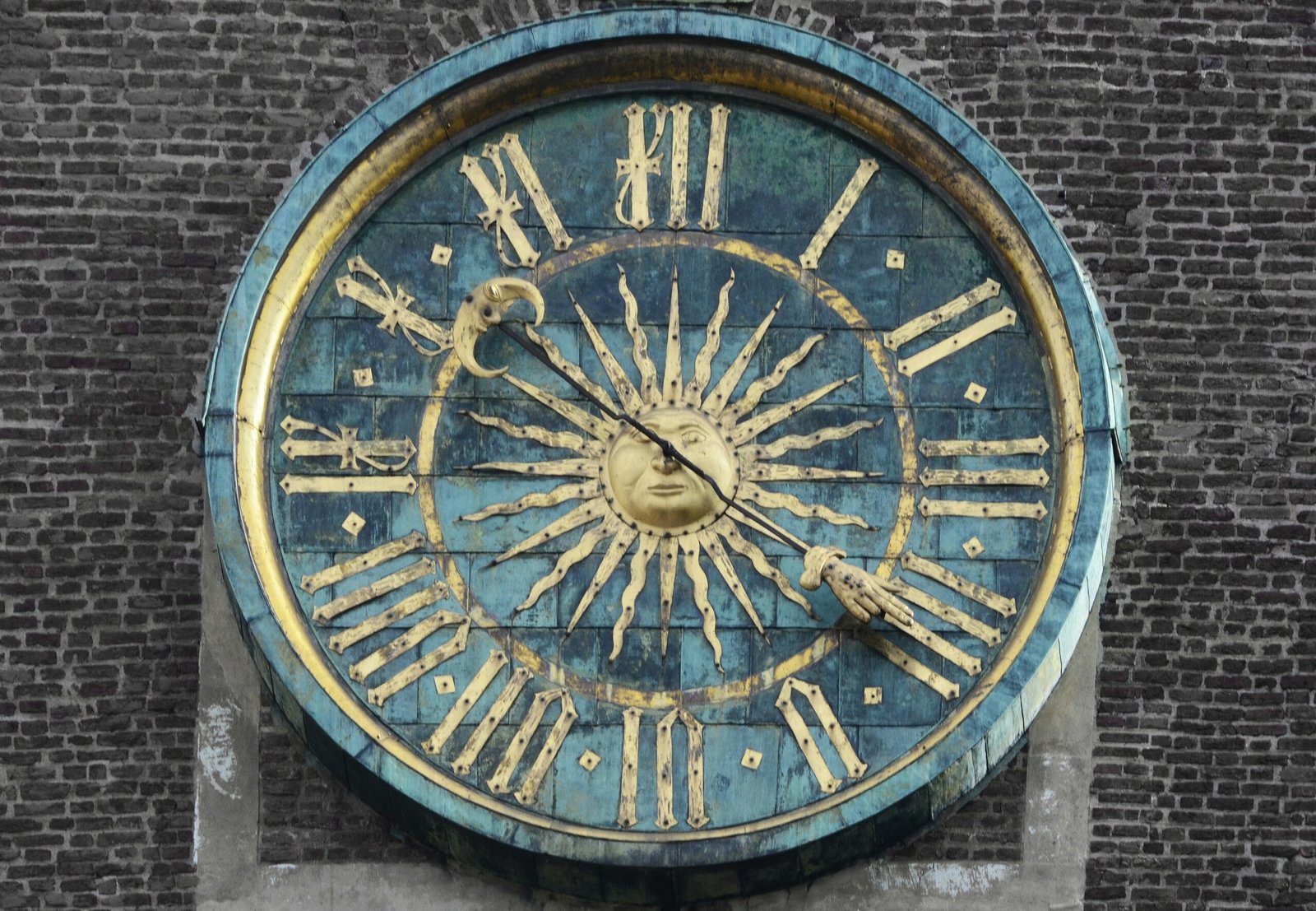
Time is the one resource we cannot store, save, or stop. Yet, for as long as humans have walked the earth, we have been obsessed with measuring it.
Today, we glance at our smartphones or computer screens and see the time displayed down to the minute, synchronized instantly with satellites orbiting thousands of miles above us. We take it for granted. But the journey to this level of precision was not easy. It was a 5,000-year struggle of engineering, astronomy, and accidental discovery.
From the shadow of a stick in the sand to the vibration of cesium atoms, the history of timekeeping is really the history of civilization itself.
The Shadow Trackers: Sundials and Obelisks
The earliest “clocks” were the celestial bodies themselves. Early humans realized that as the sun moved across the sky, shadows moved across the ground.
Around 3500 BCE, the Ancient Egyptians built massive Obelisks. These tall, four-sided monuments weren’t just religious structures; they were primitive clocks. The moving shadow allowed citizens to divide the day into two parts: morning and afternoon.
Later, these evolved into Sundials. By marking specific lines on a flat plate, the Greeks and Romans could divide the daylight hours into “temporary hours.” However, this system had a fatal flaw: it only worked when the sun was shining. At night, or on cloudy days, time effectively stopped. Furthermore, because days are longer in summer and shorter in winter, an “hour” in July was much longer than an “hour” in December.
The Flow of Time: Water and Fire
To track time without the sun, ancient engineers turned to the elements.
The Water Clock (Clepsydra): Used in Babylon and Egypt around 1600 BCE, these were stone vessels with a small hole at the bottom. Water would drip out at a constant rate. Markings on the inside of the vessel measured how much time had passed as the water level dropped. They were surprisingly accurate and were even used in Roman courts to limit the speaking time of lawyers.
The Candle Clock: In ancient China and later in medieval Europe, marked candles were used. As the wax burned down to a specific line, you knew an hour had passed. Some ingenious versions even had nails embedded in the wax. When the wax melted, the nail would fall onto a metal tray with a “clank”—the world’s first alarm clock.
The Rhythm of Physics: The Pendulum
The true revolution in timekeeping didn’t happen until the 17th century, thanks to a serendipitous observation by Galileo Galilei.
Legend has it that Galileo was sitting in a cathedral in Pisa, watching a chandelier swing back and forth in the breeze. He noticed that whether the swing was wide or short, it seemed to take the same amount of time to complete a cycle. This property is called “isochronism.”
In 1656, Dutch scientist Christiaan Huygens used this discovery to build the first Pendulum Clock. Suddenly, humanity went from measuring time with an error of 15 minutes a day to an error of just 15 seconds a day. This leap in precision allowed for the addition of a new hand on the clock face: the minute hand.
The Quartz Revolution
Fast forward to the 1920s. Mechanical clocks were works of art, but they were fragile. Temperature changes and gravity affected the gears. We needed something more stable.
Enter Quartz.
Scientists discovered that if you run an electric current through a quartz crystal, it vibrates at a hyper-specific frequency (usually 32,768 times per second). This “piezoelectric effect” became the heartbeat of modern timekeeping. By counting these vibrations, clocks became incredibly cheap and deadly accurate. This technology is likely what powers the wristwatch you are wearing or the wall clock in your office today.
The Atomic Age: Redefining the Second
As our technology advanced (GPS, internet, space travel), even quartz wasn’t accurate enough. We needed a standard that never changed, no matter what.
In 1955, the first accurate Atomic Clock was built using Cesium-133 atoms. Scientists realized that when these atoms are bombarded with energy, they oscillate (tick) exactly 9,192,631,770 times per second. This number is so consistent that it is now the official scientific definition of a “second.”
These clocks are accurate to within one second every 100 million years. They are the backbone of the GPS system. When you use Google Maps, your phone is calculating your position based on the time it takes for a signal to travel from a satellite to your pocket—a calculation that requires atomic-level precision.
The Digital Age
Today, timekeeping has moved from physical objects to digital code. Our devices don’t “keep” time; they “fetch” it from Network Time Protocol (NTP) servers synced to atomic clocks.
However, the need to measure specific intervals remains. Whether it is an athlete tracking a 100-meter dash or a chef timing a soufflé, we still rely on the tools of measurement. The difference is that now, those tools are accessible instantly in our browsers.
Modern digital tools, like our Precision Stopwatch, use your computer’s internal processing speed to track time down to the millisecond. We have come a long way from watching shadows lengthen on the sand.
Conclusion
The history of timekeeping is a testament to human ingenuity. We refused to be bound by the rising and setting of the sun. We wanted to quantify existence, slice it into hours, minutes, and seconds, and use it to organize our world.
So the next time you set an alarm or check the time, remember: you are using a system 5,000 years in the making.