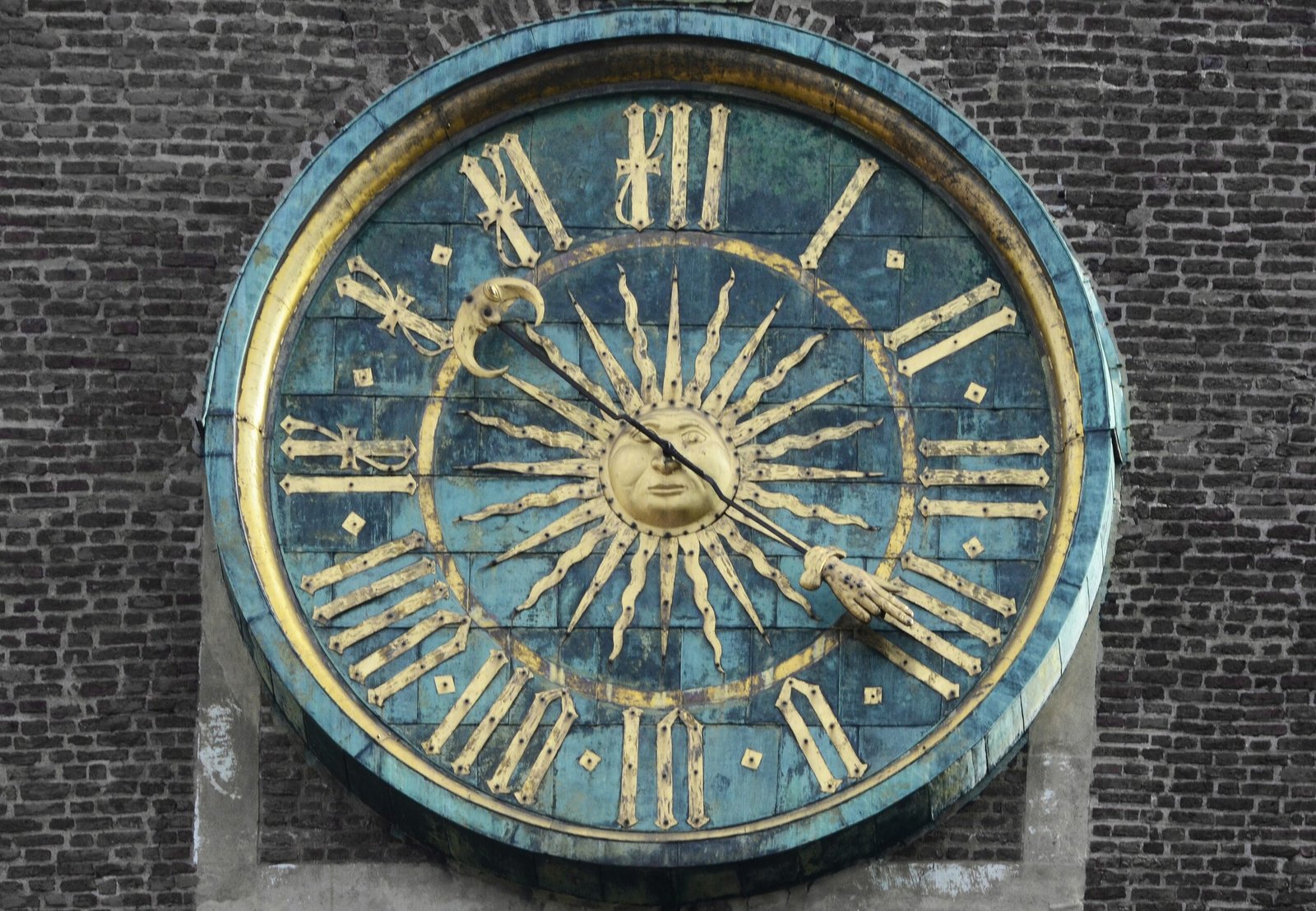
A sundial, a pendulum clock and a browser clock do not obtain time in the same way. Understanding the reference behind a reading helps separate a clock’s display from its accuracy.
Observation and repeatable intervals
A sundial follows the Sun’s apparent motion through a shadow. It depends on daylight and location, and its solar reading is not identical to modern civil time. A water clock uses a physical flow to mark an interval; construction and flow consistency affect the result. Neither a clear scale nor a neat display removes those dependencies.
Mechanical regulation
Mechanical clocks divide time with a regulating mechanism and gear train. Pendulum regulation was an important improvement: Huygens’s pendulum clock dates to 1656. Its useful regularity still depended on the instrument and conditions. NIST’s history of the revolution in timekeeping describes that development in context.
Quartz and atomic references
Quartz timekeepers count an electronic oscillator. Atomic timekeeping uses atomic transitions as a reference. The international second is defined through cesium-133 at 9,192,631,770 periods of the specified radiation. NIST’s brief history of atomic time explains how that standard developed.
A standard defining the second does not mean every consumer device displays it perfectly. A device still needs its own hardware and a way to set or synchronize its clock. NIST’s timekeeping and clocks FAQ provides further background.
What XClock inherits
XClock’s Clock reads the date and local time supplied by your device. It does not independently contact an atomic clock or calculate a correction for your machine. If the device time or time zone is wrong, the browser display can be wrong too.
The Alarm creates a target using that local date and time. The Stopwatch calculates differences between device-clock timestamps. The current Countdown instead decreases its remaining seconds as scheduled callbacks run. Those are separate implementation choices, even though the tools share a website.
Display detail is not calibration
A stopwatch showing hundredths provides a useful reading format. It does not certify the device clock, browser scheduling or the user’s reaction time. This is the modern version of the same basic question: what reference and mechanism produced the reading?
Try the Clock beside your device’s own clock, then read XClock’s timing methods to understand what that comparison can and cannot establish. Our testing record deliberately separates functional checks from claims of calibrated accuracy.